
The Hi Utsuri
Family of Utsurimono
Origins:
The Shiro Utsuri is the best known of the three main varieties of the Utsurimono family, it is well represented in breeders and at the Koi Show. Other varieties are rarer such as Hi Utsuria and even rarer for Ki Utsuris. The origin of this variety is difficult to identify, its origin is placed around 1925 but other sources give a much closer date. A Hi Utsuri can be considered as a Showa without Shiroji brands. The Hi utsuri were often of poor quality because the Hi was not very marked, but, crosses with Kohaku have improved the variety. Ki Utsuris is an old variety that would go back to 1875 and then called "Kurokihan", one should notice the Kin Ki Uttsuri variety is always well represented while Ki Ut suri has almost disappeared from our ponds. We use a couple of Hi Utsuri to produce Hi Utturi and a couple of Showa to produce Showa, it's obvious but in Showa's production you can have both Shiro Utsuris (Showa without Hi brands) and Hi utsuri (Showa without Shiroji brands), which proves that these three varieties: Showa, Shiro and Hi Utsuri have the same origin. Shiro and hi utsuri produced by a couple of Showa are usually preserved but if you want high quality, it is best to have Hi Uttsuri from a couple of Hi Ut suri.
How can I recognize a Hi Utsuri with certainty?
It is almost impossible to confuse the Hi Utsuri with another family, possibly with the Hi Bekko, but the shape of the Sumi brands is very different.
Item 1:
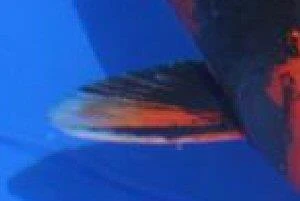
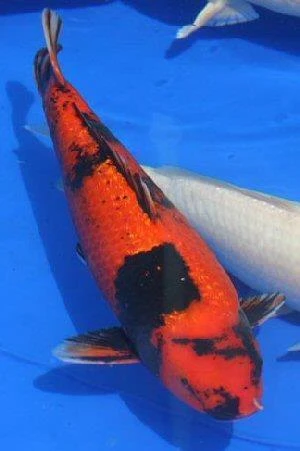
Like the Showa, the Hi Utsuri has Motoguro, i.e. black spots at the base of the pectorals.
Item 2:
The Hi Utsuri has Sumi on its head. The mark on its head is called Hatchiware or Menware.
Item 3:
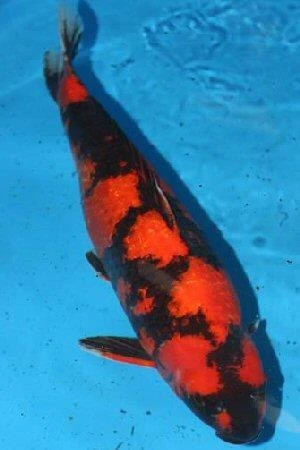
The Sumi drawing of Hi Utsuri is in the form of large spots that can pass under the lateral line because it is the basic color of the fish. There can only be black (Sumi) and red (Hi) as colors, if there is Shiroji, it is a Showa.
How to judge the quality of a Hi Utsuri?
1. The Hi and Sumi are well drawn over the whole body.
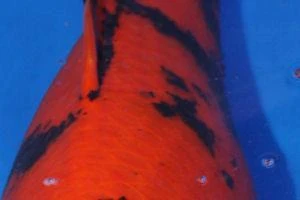
2. The Hi is really red without traces of Shimi.
3. Sumi is well present on the pectorals.

Glossary:
Motoguro:
Sumi spots at the base of the pectorals. Ideally, they should represent 30% of the surface. This should appear on varieties from Karasugoi such as Showa, Shiro Utsuri, Kumonryu, Beni Kunomryu etc.
Shimi:
Undesirable spots in the form of a single point while Jyami refers to a group of points.
Hachiware:
Describes a Sumi stain that divides the head, it's also called Menware. A good Hachiware goes from head to shoulders with an Inazuma shape. It's present on Shiro Utsuri, Showa Kin Showa and other Utsuris.