The Kohaku
Kohaku family
Origins:
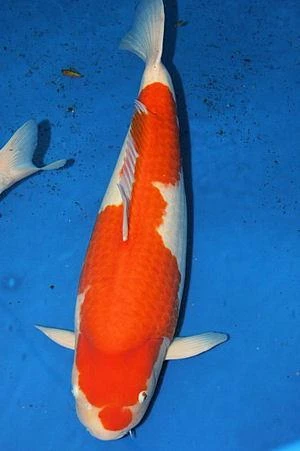
Kohaku is probably the iconic fish when it comes to Koi, it's one of the most produced varieties, its simplicity and the contrast between white (Shiroji) and red (Hi) make it a beautiful fish but because of this simplicity, the quality criteria for selection are very strict and simple details can make the difference between a beautiful Kohaku and a "Champion". During the spontaneous mutation of the Magoi, the characters specific to Kohaku gradually appeared, red head, red ears, red spots on the body and belly. In 1888, a person named Gosuke crossed two Kohaku and it was the beginning of the Gosuke lineage that is currently extinct. The current lines, Tomoin, Sensuke, Yagozen etc. From this original lineage, the Kohaku tradition continues with breeders like Dainichi. Kohaku exists in Kinginrin and Doitsu.
How can you recognize a Kohaku with certainty?
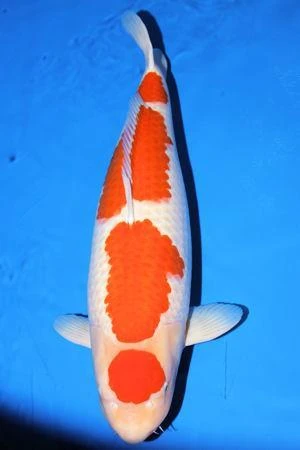
The Kohaku is a fish that has a Shiroji background color (White) and not Platinum (Platinum), it has large Hi (Red) spots spread over the body. Its body has a matte and not metallic reflection. One could confuse the Doitsu Kohaku with a Kikusui which, has a Platinum background color because it was crossed with a Platinm Ogon but Kikusu is part of the family Hikari-Moyomono.
Item 1:
The Kohaku has a Shiroji background color and Hi color marks, no other color is present. The body has no metallic reflections.
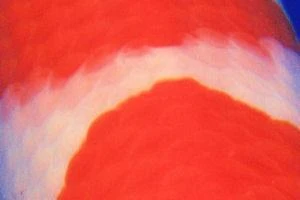

Item 2:
The marks are large, sometimes there is only one from the head to the tail. The scales have no Ai (Indigo) brand in the center or on the edge (Drawin Matsuba).
Item 3:
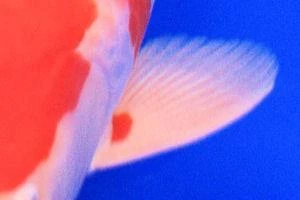
The fins are white with possibly a small Hi spot at the junction between the pectorals and the body.
How to judge and choose a Kohaku?
1. The nose of the fish and the part just before the tail must be Shiroji (White).
2. The head cannot be entirely white or red.
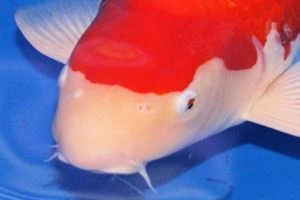
3. The red of the head may cover one eye but not both.
4. The colour of the eyes is white and not blue.
5. The fins cannot have Sumi spots as well as the body, possibly a small Hi mark at the junction with the body.
6. Shiroji must be white as snow.
7. Hi marks must be large, well marked and deep red.
When one observes a bowl filled with young Kohaku, the first thing to look for is a white mark on the head and also another just before the caudal fin. It is important that the red of the head does not exceed the level of the nostrils of the fish, do not choose a Kohaku with the head entirely red or white. A red mark on the lips (Kuchibeni) is allowed, but only if the spot is small and the rest of the red of the head does not exceed the limit of the nostrils. Normally red is not allowed around the eyes but for some years it is tolerated for one eye but not for both.
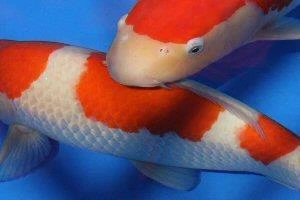

Below, to the left, a Hi mark on the perfect head that starts just ahead of the eyes and is slightly curved forward. To the right, the Hi mark of the head covers an eye, which is currently tolerated.
An ideal Kohaku should have on the head of the Shiroji from the tip of the nose to a line located a little ahead of the eyes called (Medaira). Then comes a Hi mark on the head called Toh Hi, the last mark must end at the rear part of the fish (between the back of the dorsal fin and the beginning of the tail) so as to leave a white area before the tail. The separation between the Hi and the Shiroji at the rear of the fish is called Odome. Below, to the left, the last Hi mark ends well before the tail of the fish, which is a good Odome . To the right, the Hi mark at the pectoral level (Motoaka) is tolerated if it remains very discreet.
The possible red spots present on this back part of the fish are called Odome Hi and can if they are too important strongly influence the quality of the fish. In short... the Toh Hi (red on the head) and the Odome Hi (red in the tail zone) must balance because the fish that have this balance seem beautiful to the eyes of the profane even if they do not know very well why. The head is the most important part for a young Kohaku, then look at the rest of the body, Hi marks must be balanced and cover +/- 70% of the visible surface of the fish.
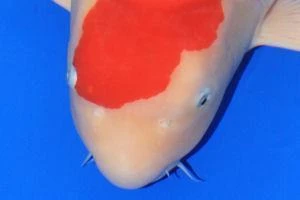
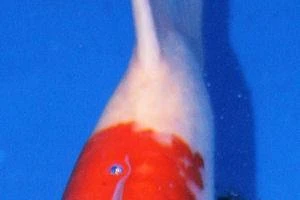
Make your choice, you're at Sakai Fish Farm.
It is necessary to initially, many areas covered by the Hi on the fish because, by growing the Shiroji brands grow faster than the Hi brands. Having many Hi brands at the start (+/-70%) one is sure that when the fish will be large, there will remain enough. Look for a fish with wide shoulders and large pectoral fins, this usually indicates a fish with great growth potential. It is not necessary to focus too much on the color of a young Kohaku, it is better to have a white Shiroji as snow but it is possible that it is slightly pink if the fish has received a diet containing carotene, what should be avoided is a dirty white, greyish. Hi when to him, can already be very deep or even orange red, many Kohaku of an orange Hi will have the Hi that will become a deep red growing. The fins of the fish must be devoid of any Hi or Sumi marks, a small Hi mark is only allowed at the junction between the pectorals and the body. The body must not show any Sumi marks and the Hi marks must have a certain size, avoid the Hi marks limited to a single scale. The eyes of a Kohaku are white and not blue.

Varieties and Sub Varieties
The Kohaku Doitsu The Kohaku Kinginrin Kohaku Dotsu variety of Kohaku, i.e. without scales or only on the back. Kinginrin variety from Kohaku with brilliant scales.
The Kohaku Inazuma The Maruten Kohaku For this variety, the drawing is in one piece and in the form of lightning from head to tail.
For this variety, the head is decorated with a round Hi brand and there are other Hi marks on the body otherwise it would be a Tancho Kohaku.
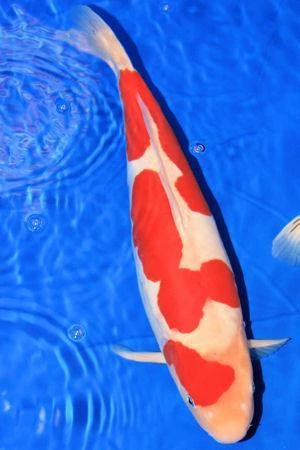
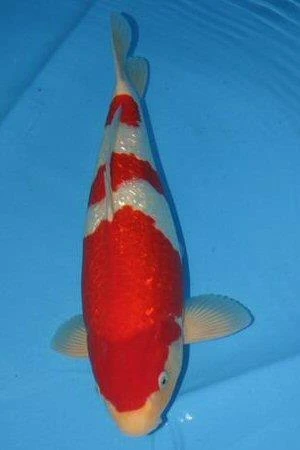
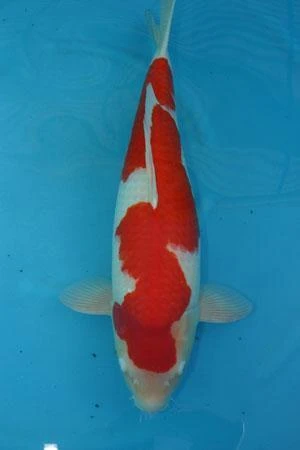
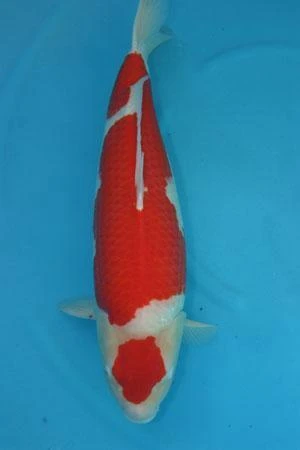
The Kohaku Sandan The Kohaku Nidan Kohaku Kohaku variety with three Hi brands on the back.
Kohaku variety with two Hi marks on the back.
The Yodan Kohaku The Maruten Yodan Kohoku Kohaku Variety with four Hi brands on the back. Kohaku variety with four Hi marks on the back including one centered on the head.
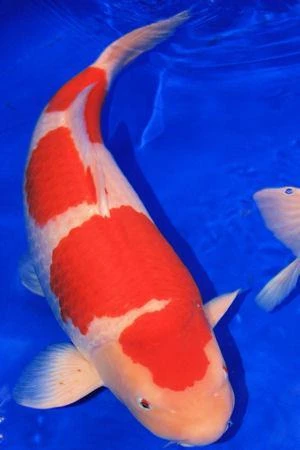
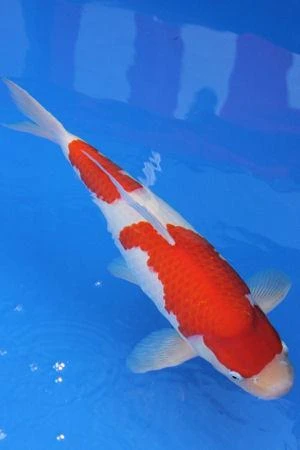
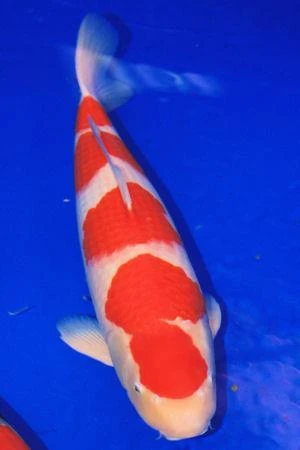

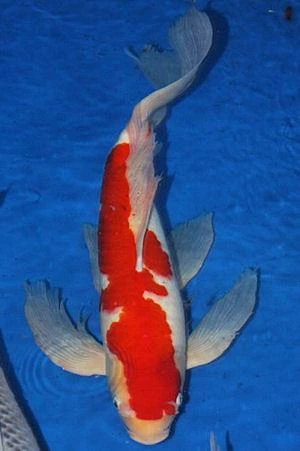
Moyos Kohaku The Butterfly or Longfin Kohaku Kohaku Variety, a single big brand that goes from head to tail.
Kohaku veiled variety, the result of crossing with an Indonesian veiled carp.
Glossary:
Medaira:
Imaginative line between the eyes, this is the ideal beginning of the drawing on the head. When the drawing begins at the level of this line, the drawing is considered light. An ideal drawing starts slightly ahead of this imaginary line and must be slightly curved towards the mouth.
Odome:
Line of separation between the last Hi or Sumi color and Shiroji in the area of the tail. A good "Odome" must show a clear line and a Shiroji area before the base of the tail of the fish.
Toh Hi:
Name of the Hi marks on the head. Odome Hi Red drawing in the tail area.
Kinginrin:
Bright scales like diamonds, with a "gold" reflection called Kin on red and "silver" called Gin on white.
Kuchibeni:
Meaning Lipstick, a Hi brand on the lips, which can be very charming.
Motoaka:
Tache Hi at the base of the pectorals, it is a negative point for a Kohaku, however it is a characteristic of the Asagi and Shusui.