
The Ogons
Family of Hikari Mujimono
Origins:
The Ogon are metallic and unicolored Koi. They are known as "Ogon". "Hikari" means "glossy or metallic". "Mono" when to him, means "one" and finally "Ogon" means "doré". We will often hear different names that include "Muji" which also means "one". By calling a Family "Hikari Mujimono", it seems to say twice the same thing but it is the correct name of this family. To complicate a little the thing, Matsuba varieties are in the same family because these fish actually have only one color. Around 1921, Mr Sawata Aoki captured in a stream a Magoi with golden lines on his back. Fascinated by this discovery, he began to select fish with these golden lines, and, four or five generations later, old varieties such as Ginbo, Kinbo, Kin Kabuto and Gin Kabuto were created. The currently worthless varieties are the origin of Ogon. Doitsu varieties also exist for Ogon, a Doitsu Purachina Ogon in this case.
Since Mr Sawata Aoki produced the first Ogon in 1947, many breeders have produced a lot of Hikarimono based on this Ogon. The Nishikigoi are often described as living jewels that capture the hearts of amateurs around the world. Hikarimoni have contributed greatly to this popularity. A Ogon can reach the size of 80cm in 8 years. L的Ogon was created 50 years ago, at first it had only metallic gold shine. Now, the Ogon exist in several colors, the most common is the Purachina Ogon (White Platinum) and Yamabuki Ogon (yellow brilliant sometimes gold colour), but many other stable varieties exist such as Cream Ogon (pale yellow), Nezu Ogon (grey), Orenji Ogon (orange), Hi Ogon (red) and least known such as Mukashi Ogon (bronze), and Kuro Ogon (black). The Ogon are a family in which it is easier to observe high quality skin, which can distinguish an exceptional Koi from a very good Koi.
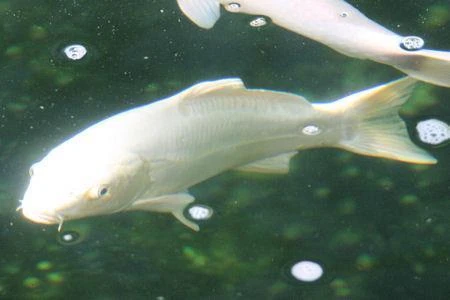
The Fukurin is particularly visible on the Ogon.
Other families such as Yamato Nishiki, Kujaku, and Kin Showa have been developed one after the other all finally including Ogon. There are Doitsu varieties of Ogon.
How can you recognize an Ogon with certainty?
An Ogon is a unicolored fish with a strong metallic appearance. The pectorals are fully coloured. Fukurin is easily visible on a certain size Ogon but it is no longer a characteristic limited to this family.
Item 1:
Ogon is a fish with only one color.
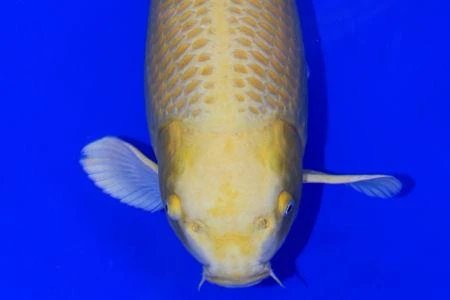


Item 2:
The Ogon has a strong metallic brilliance, especially at the head.
Item 3:
The scales do not bear a Matsuba drawing.
Developments:
When young, the whole body is bright but when it exceeds the size of 70cm, the Fukurin's net look will appear, it is at this time that the Hikarimono become the most beautiful. Amateurs should always try to make them grow up to Jumbo size. This "skin quality" is called Fukurin or Amine, not to be confused with the Ginrin which are brilliant scales and the Hikari which is a Koi with metallic appearance. Fukurin gives a slight cross-linked effect to the fish, it is as if a small net was placed on it. This effect is present because the skin appears between scales and the difference of reflection and colour between scales and skin gives this crosslinked effect called Fukurin. 30 years ago, the Koi reached a maximum size of +/- 60 cm and the Ogon was the only one with Fukurin . This was the reason why we thought that only the Ogon could have it. Now almost all the Koi can reach a size of more than 80cm and, at this size, each fish can have Fukurin but this is never a certainty.
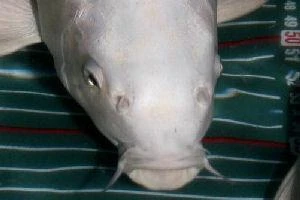
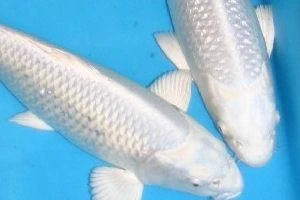
How to judge the quality of an Ogon?
1. The metallic brilliance must be regular.
2. The colour must be regular.
3. The shape of the body must be perfect.
4. The head shall be without stains.
5. The pectorals shall be well coloured and with a strong metallic radiance.
6. Fukurin is a plus.
Because the Ogon are unicolored, the selection criteria are strict. Of course, the body conformation and skin quality are very important, but for a metallic Koi, the chandelier must be well distributed and well pronounced over the whole "body" of the fish. For an Ogon, the entire pectoral is coloured unlike non-metallic varieties in which the outer edge of the pectorals is almost transparent. The Ogon grow very quickly and are among the least fierce. Choguro, is a breeder of Jumbo Yamabuki Ogon well known in Japan is Izumiya and for the Platinum Ogon. For the selection of a young Ogon, as for many Koi, it is necessary to observe initially the head that must be unicolored, without stains and with a very important lustre, the scales and pectorals must be very shiny and the pectoral well developed, the scales must be well aligned and symmetrical, they must guide the look towards the tail. Varieties and Sub Varieties.
Yamabuki Ogon Platinum Ogon. This color is called Yamabuki because in Japan there is a pink with this bright yellow. Based on Yamabuki Ogon, breeders have created the Kin Showa and Kin Ki Utsuri. On this fish, the Fukurin that gives a cross-linked look is well present.
Platinum was produced from Nezu Ogon (an ancient metallic grey variety) and Kigoi. It played an important part in the creation of other Hikarimoyo, a good example is Yamato Nishiki which is the result of the crossing of Sanke and Platinum or Kin Showa which is the outcome of the cross between a Showa and a Platinum. Many more Hikarimoyo come from Platinum.
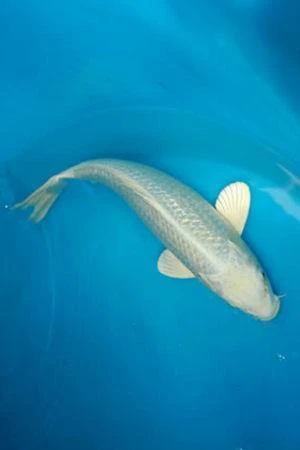
The Nezu Ogon Koi metallic grey.
