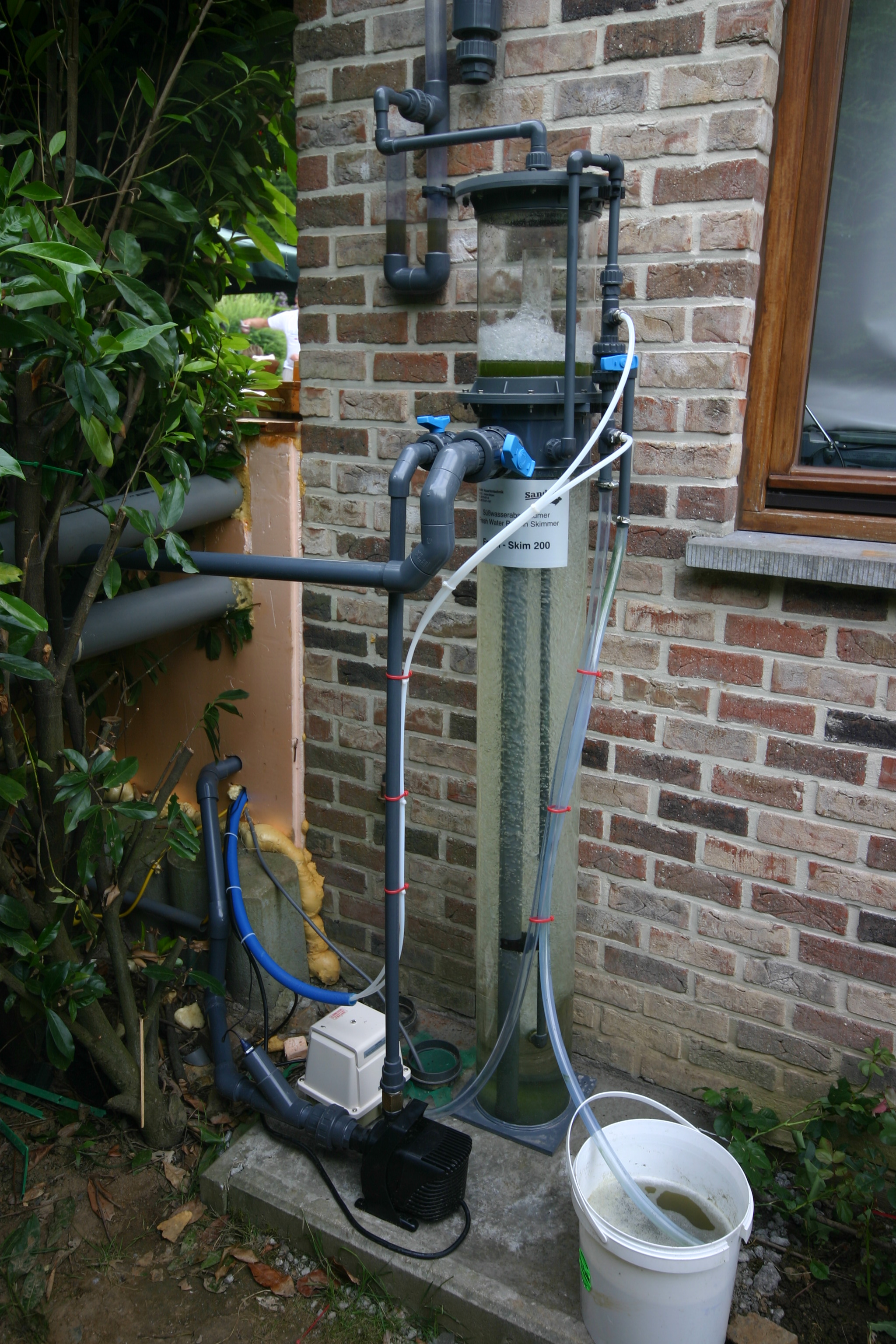
In this article, you can see the working principle of a scummer, its ability to remove organic matter from water (proteins and others), its ability to relieve biological filtration and clear water from a pond.
You can also see the many advantages of a well-designed skimmer. You can observe that all parts and different parts of the skimmer are detailed and explained in their functions, this to give you the opportunity to make your own skimmer yourself. You are also explained how to get a good foam with details about the process and how.
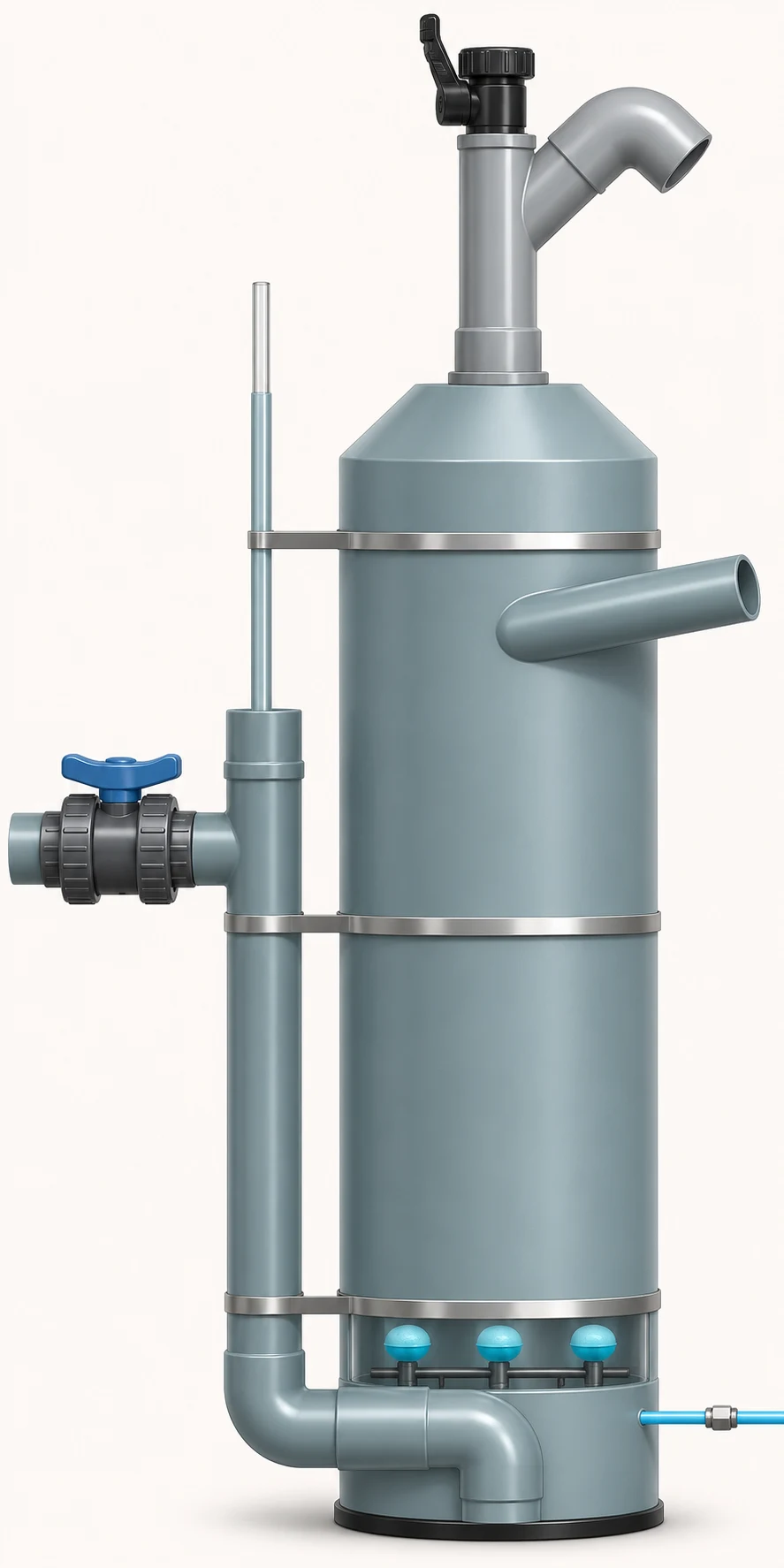
The scummer is a very useful water purification device, mainly to reduce the organic load before the water reaches the biological filter. Given what it removes from the water, it was used in freshwater and seawater aquaculture, but long before that, it was already used in industry for waste treatment for several years.
The principle of smoking
The skimmer principle is to inject air into a tube filled with highly charged organic water (DOC), with the intention of removing it in the form of foam (scum), also known as absorbent because of the peculiarity of air bubbles in the water to exert a phenomenon of attraction and absorption on the organic matter contained in the water. By injecting air in fine bubbles into the water of a tube, the very numerous and compact bubbles continuously lead to a current up this tube, above the water level (against the water flow). All the fats stick to the air bubbles by the phenomenon of absorption and sizing at the top of this tube where they are trapped. The formation of the foam (scum) is produced continuously, so they can no longer fall down as the protein and nitrogen matter simmer, so there is a form of foam which eventually rises up to the point of exit from the tube, while the clean water moves back into the pond or the biological filter.
What does a scummer get out of water?
It removes water from molecules, particles, nitrogen products as well as colloids and many other things.
Molecules
Hydrophilic molecules ("that like water"), hydrophobic molecules ("which don't like water"), or lipophiles (organic solvents), are soluble in fatty bodies but insoluble in water ("repellent water"). Some examples of molecules that interest us are proteins, fatty acids, ammonia, oils, fats, amino acids, phosphate, salt and almost all inorganic components soluble in water.
Particulate matter
The scummer treats particles or suspended matter in water (MES), decomposed waste, suspended algae, decomposed material and many other organic compounds dissolved in water (Cod) due to pollution and other phenomena. This scummer deals with water soluble material and very small organic particles.
- The first advantage If you know that a quantity of protein gives the equivalent in ammonia, by this advantage you also have a reduction of nitrates since these are the end of the nitrogen cycle that is being processed in your biological filter and that it will not have to treat.
- The second advantage is thinning water by removing the substances mentioned above, without the use of any product.
- The third advantage : a very strong oxygenation of water for the biological filter or for your pond if it does not pass through the filter.
- The fourth advantage : during the cold periods of the year when your filtration is slowing down, your skimmer turns at full efficiency, keeping the same efficiency, even with very cold water.
- The fifth advantage : one can still mention the extraction of residues from medication (after treatment) and many other chemicals ...
- The sixth advantage A skimmer of this type allows a safe injection of ozone for bacteria in your biological filter or for the occupants of your pond.
Operation of the skimmer
See the animation of the skimmer
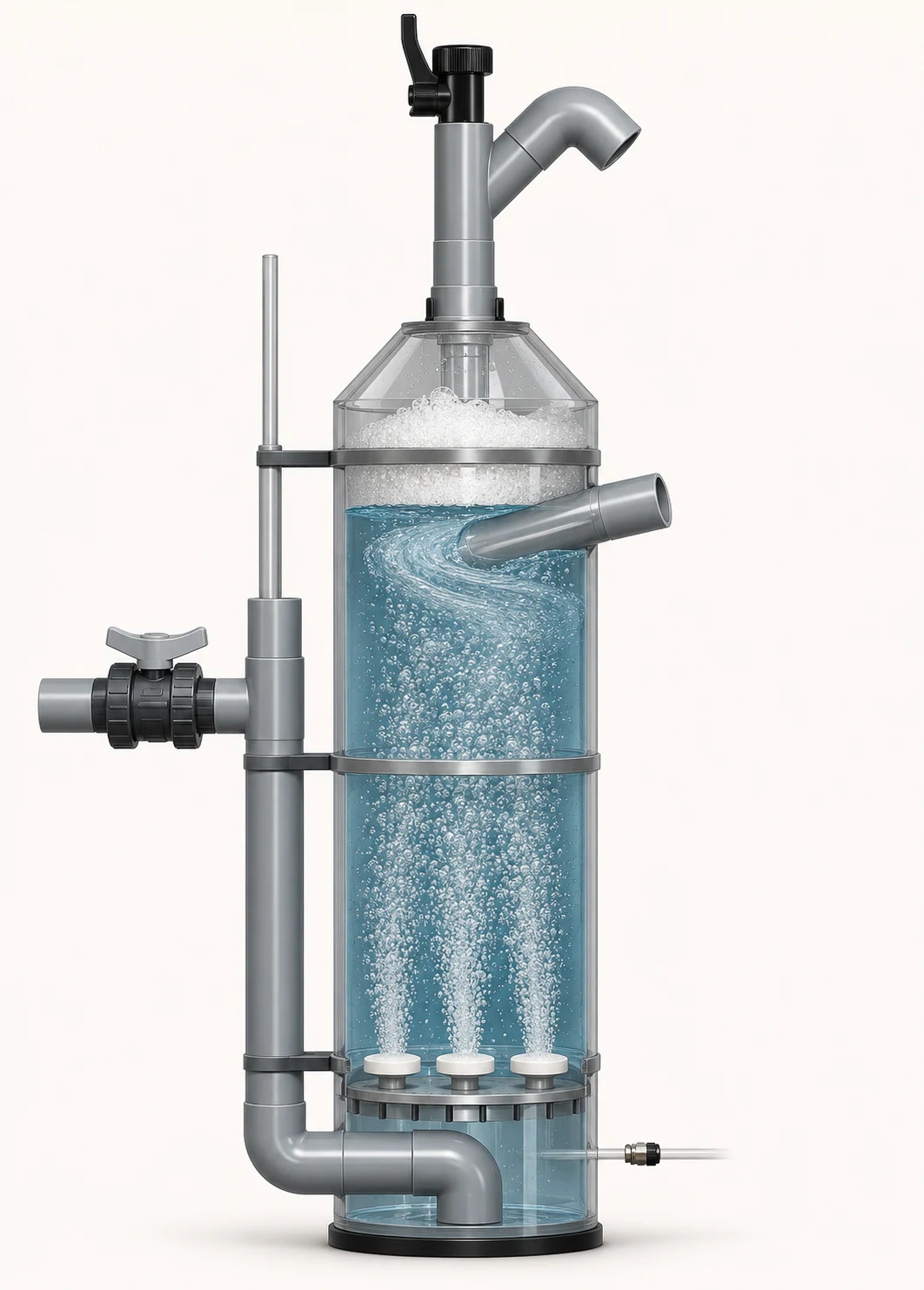
The function of a skimmer is to inject air into a volume of water in order to bring out soluble, organic (DOC) and other materials (see above) in the form of foam. For a skimman to function properly, it needs a large air-water interface, meaning an area that separates two elements. For us, it will be the tube (injection chamber) where water and air will be injected. For bubbles to charge a maximum of organic matter, bubbles need the longest possible contact time with water, hence the minimum tube height, estimated at 61 cm for the tube, not counting the upper part (elevation tube) where foam is formed for the smallest skimmer of this type. This time is necessary to have enough air/water contact time to obtain well charged bubbles that will eventually form the foam.
The tangential system which, by rotating the water in the shape of a spiral in the tube, has the effect of delaying the descent of the water is equivalent, at least, to three times the height of the tube in comparison with a normal descent of water. This prolongs the contact time between air and water and allows bubbles to charge maximum organic matter, with the aim of achieving maximum efficiency in quantity and quality of foam.
For the operation of a skimmer, several water intakes are possible. A normal water intake with bubblers (air diffusers) in the bottom of the tube, counter-current system, the most efficient, preferably tangential. A venturi injection (type Mazzei) in tangential mode is very efficient but very energy consuming with an injector (e.g. foaming jet from Oase). Let's add that venturis also consume a lot of energy.
For the production of bubbles with bubblers (air diffusers), placed in the lower part of the tube for the counter-current system, attempts are made to place as many bubbles as possible without obstructing the passage from water to the outlet, in order to obtain a sufficient volume of air bubbles as small as possible.
The more diffusers you have, the smaller the air bubbles for the same pressure and air pump flow (air compressor). The first reason to have small air bubbles is that the smaller the bubbles and the larger the surface of all its small bubbles. In a large bubble, you can put dozens of small bubbles in it. If you develop to get the surface of these small bubbles that are in the big bubble, you will find that the surface of the small bubbles, which are in the large bubble, is several times higher than the large bubble. So, small bubbles will have more surface to charge with organic matter. The second reason is that when large bubbles come to the surface of the water, they burst and cause the foam to fall, and organic matter at the same time.
Scum
When the bubbles are loaded with organic matter and rise to the surface of the water in the skimmer, they gather together and agglutinate one another. There is a foam formation which takes place in the upper part of the skimman (the scum-elevating tube). The foam forms as it rises up and ends up coming out of the scummer.
Before coming out of the drain tube, the bubbles, forming the foam, allow most of the water to come down again, which has the effect of drying the foam. However, a foam too dry will have lost many organic materials. This is why it is sought neither too dry nor too wet, but very compact, which gives after settling in a container a water colour dark tea and not black.
With a foam that is too wet and less compact, bubbles burst into the top of the drain tube and organic matter returns to the water. While with a foam too wet, you will come out a lot of water, but no more organic matter. You just have to look at the color of the liquid that is in the recovery container. With a foam too dry, which has lost a lot of water, we will also lose a lot of organic matter. At times in the drain tube, you will see the foam collapse. A good foam is a compact foam, neither too dry nor too wet, that continuously exits from the elevation tube and which, after settling in the recovery container, gives a water color of dark tea.
Until the desired foam is obtained and until the foam production remains stable, it must be understood that at the start of the skimmer, you will have a very large amount of foam which will decrease afterwards. It is by adjusting the height of this tube that you can adjust your skimmer to obtain the desired foam quality, but you must understand that at some point, when your skimman has done his job, there is nothing left to foam, which is rare, even in cold times.
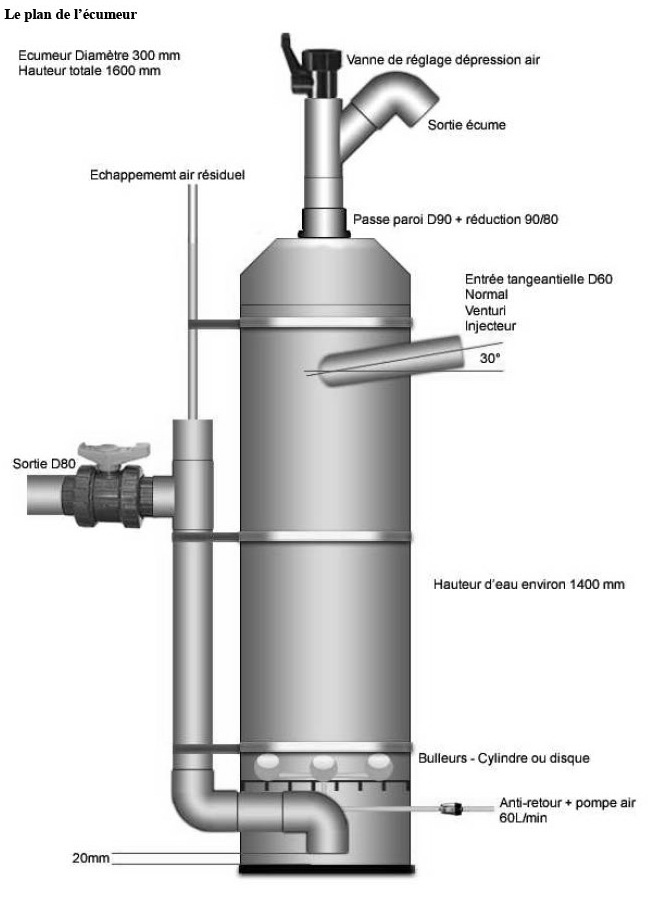
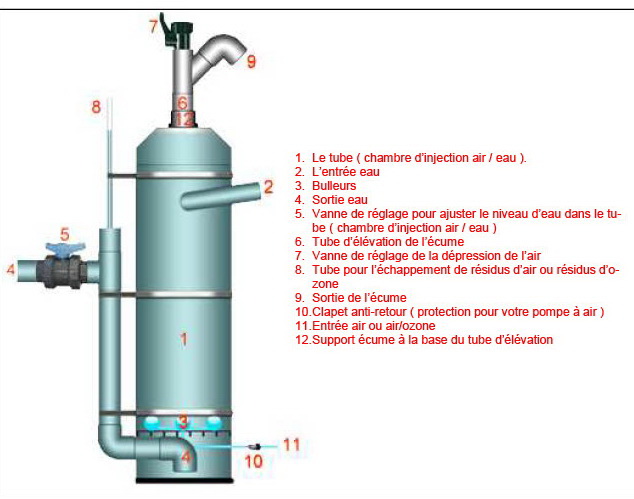
♦ The 1-chamber tube of 300 mm diameter air/water injection for a height of 1400 mm, you must respect the total height of the tube. For a few centimetres more, you will have a great decrease in speed of your air pump (air compressor).
♦ Water intake 2 is placed lower than the water level, so as not to disrupt the formation of the foam by turbulences due to water injection. The entrance will be placed in a tangential manner, i.e. at an angle of 30° upwards from the horizontal of your tube. It will have to be placed on the tube so that the water, when entering the tube, marries the inner part of the tube to turn inside. The water inlet has a diameter of 60 mm to have less head loss for normal inlet, and to be able to adapt other injection systems, as mentioned above.
♦ The bubblers 3 will be in sufficient numbers to produce a maximum of small bubbles.
♦ The outlet of water 4, 80 mm in diameter, is 20 mm from the bottom, in the lower part of the tube and in the centre, largely sufficient for a flow of 10000 litres of water. But also to have a good mixing in the bottom of the tube so as not to have a deposit of organic residues which would not have been absorbed by the bubbles.
♦ The adjustment valve 5, at the outlet of the tube, serves simply to adjust the water level in the tube (injection chamber), and does not play any role in the water flow, once the water level has been adjusted to 10 or 20 mm from the top part of the cone that finishes the injection tube. It will not be affected any more if there is subsequently a decrease in level. See pump (cracking or other).
♦ The elevating tube of foam 6, with a diameter of 80 mm or 90 mm for a wall pass, is the straight part between the outlet of foam and the upper part of the injection tube (cone).
This part of the tube is not fixed; this tube is, for me, one of the centerpieces for this type of skimmer. It's the part of the skimmer where you can make adjustments. The other parts being fixed, it means that the flow is fixed by the pump used and the outlet valve is used to adjust the water level in the tube, and we don't touch it anymore.
At the first start of your skimmer, you can place a tube (elevation of foam) from 300 to 400 mm, -yes! 40 cm-, to obtain a difference between the outlet of foam and the water level of the injection tube by +/- 500 mm. After a certain operating time, when the foam decreases, you change the tube. This first tube, you can keep it for a restart of the skimmer.
Then you have to adjust another tube by decreasing its height by 100 mm, and so on until the desired foam is obtained and until the foam production remains stable. It must be understood that at the start of the skimmer, you will have a very large quantity of foam which will decrease afterwards.
It is by adjusting the height of this tube that you can adjust your skimmer to obtain the desired foam quality, but you have to understand that at some point, when your skimman has done his job, there is nothing left to foam, which is rare, even in cold times.
♦ Air pressure control valve 7: this valve, which is in the upper part of the skimmer, also allows you to adjust the quality of your foam. When it forms, there are always bubbles that burst. These bubbles release air that accumulates in the upper portion of the skimmer elevation tube, which has the effect of compressing the foam. So, by closing this valve, you slow down the escape from the foam, resulting in a drier foam and vice versa.
♦ Air exhaust tube or ozone 8 residues: as indicated, do not put too small a diameter (40 mm). This can be used by looking inside to adjust your water level in the injection tube if you have not placed a look at your injection tube.
♦Exit of foam 9 of diameter 80 or 90mm.
♦ Non-return valve 10: protection for your air pump to be placed if you do not have the possibility to put your air pump (compressor) higher than the water level of the skimmer.
♦ Air or air/ozone intake 11: this is where you connect your air pump with or without ozone concentrator. For this type of skimmer, plan an air pump of 60 litres/minute.
♦ Scum holder at the base of the tube elevation 12: the foam holder is a disc of +/- 5 mm thick with the same diameter as the d∙ elevation tube, i.e. 80 or 90 mm. In this case it is 90 mm like the wall pass. It must be drilled with as many small holes as possible in diameter of 6 mm. It is placed in the wall pass at the bottom of the elevation tube. The holder allows to support the foam. When the production decreases or when you want a drier foam, it prevents the passage of large bubbles which, by bursting, would cause the foam to fall.
♦ Which water pump to choose to power this scummer? A pump with a flow rate of 7500 to 12,000 litres/hour, but not take a pump that does not have enough power to keep the water level stable in the injection tube (low consumption cost pump).
♦ The air pump (compressor) of 60 litres/minute is sufficient.
♦ Location: preferably between the mechanical filter (grid grating filter) and the biological filter.
♦ Loss in charge: to have as little loss as possible, you can place it so that it has its water outlet just above the water level of your biological filter.
Here is another model of scummer "savio"
Here's another skimmer model " The Savio«
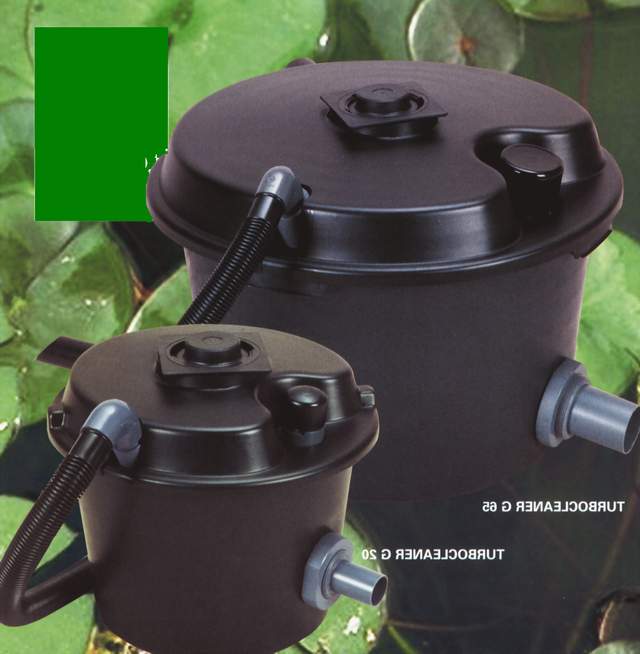
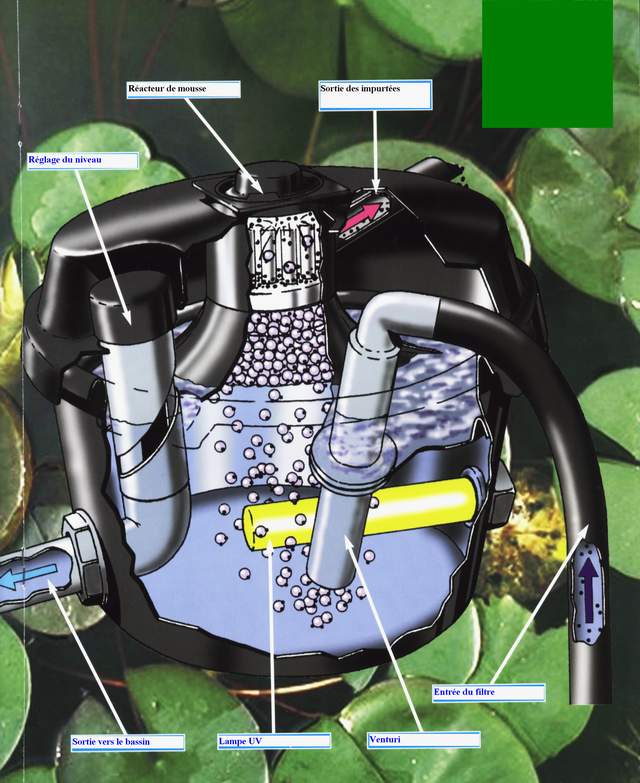
No doubt the best of the market, " The Sanders » available in several dimensions