
Filtering
The choice of filter depends on the pond, fish and hydraulic system. Discover the three filtration methods presented in this article.
Choose your filter
When buying a filter, you must consider the presence or absence of fish in your pool.
The data on the manufacturers' catalogues mainly informs you about the filtration capacity for a fish-free pond.
To determine the capacity of the filter, you must know the volume of your pond. Therefore, when filling the pond, take note of the index of the meter. To my knowledge, this is the only way to know the exact volume.
Then, when you plan to poison your pool, you have to divide by two the value given by the filter manufacturer. This calculation will ensure that you have sufficient filtration capacity in most cases.
Knowing the volume of your pond is indispensable in the case of treatments due to pests or diseases, which will inevitably happen!
The same is true with the pump; take into account the water column to be raised, you will be surprised to see how much more than expected a pump should be taken In case of pumping mode.
The three modes of filtration
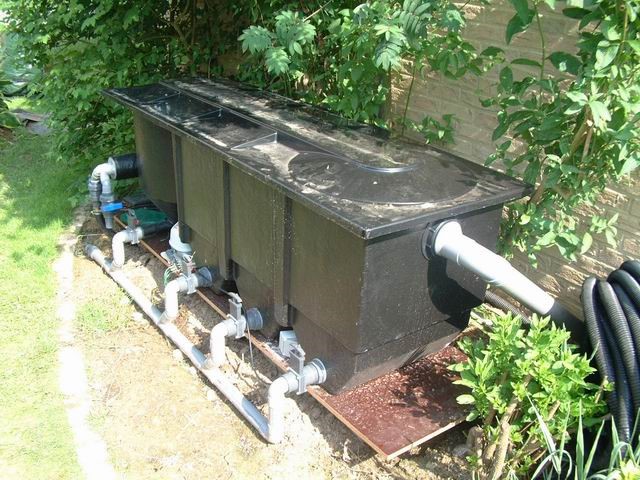
- Pumping mode
- The gravity-fed mode
- Semi-gravity-fed mode
The pump-fed mode
It is often referred to as "pump mode", or "pumping mode".
In this case, the filter is placed on the ground and is necessarily higher than the pond.
For this mode of operation, all mechanical filters are suitable, except for the grid filter which must be specifically designed for pumping.
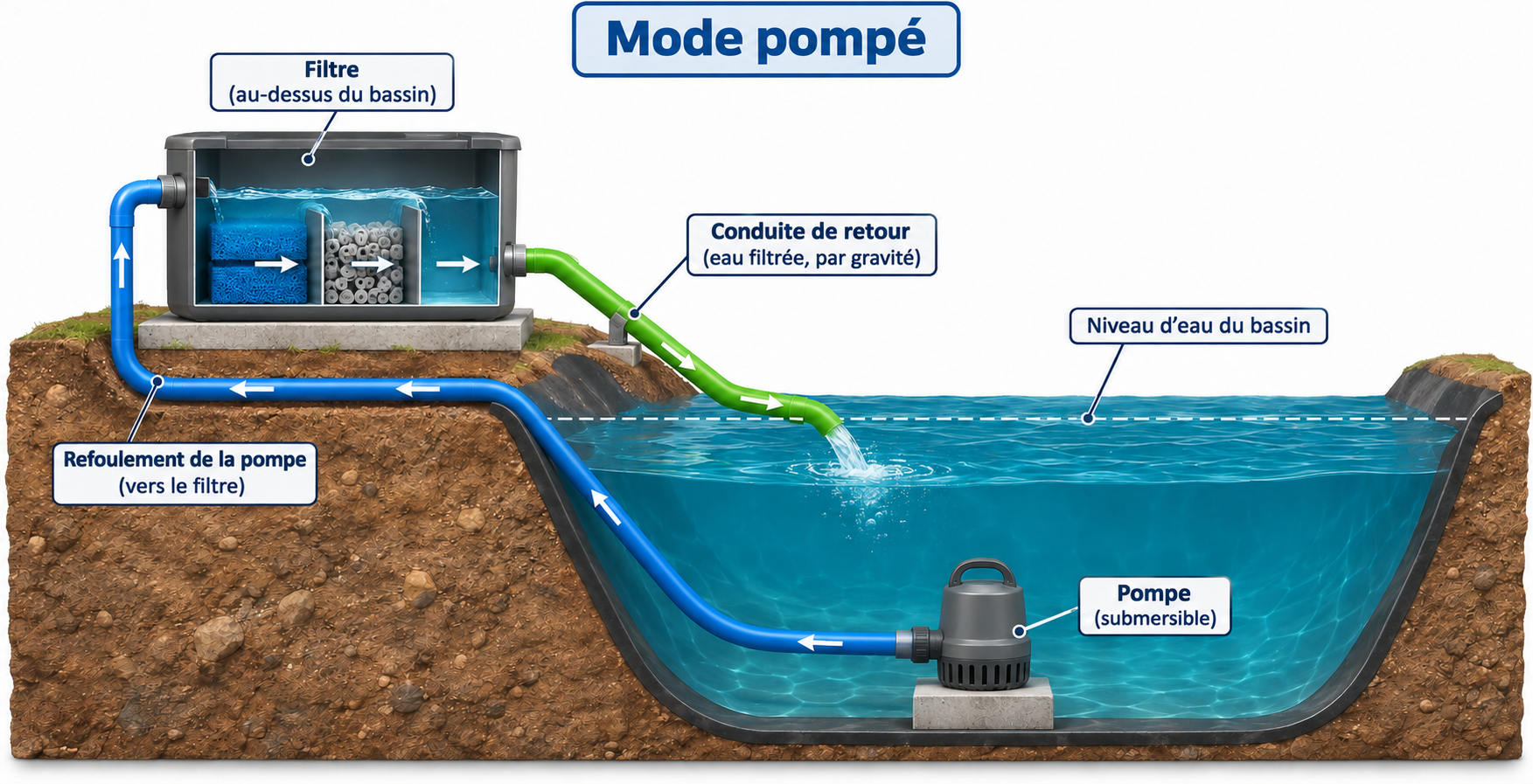
Advantage
This mode is simple to achieve; it is for this reason that it is most commonly used.
Disadvantage
Since the filter is outside the pond, it is necessary to raise water, which is expensive in terms of energy.
On the other hand, since the pump is in the pond, the waste will be chopped by the pump, making filtration more difficult depending on the type of mechanical filter chosen.
The gravity-fed mode
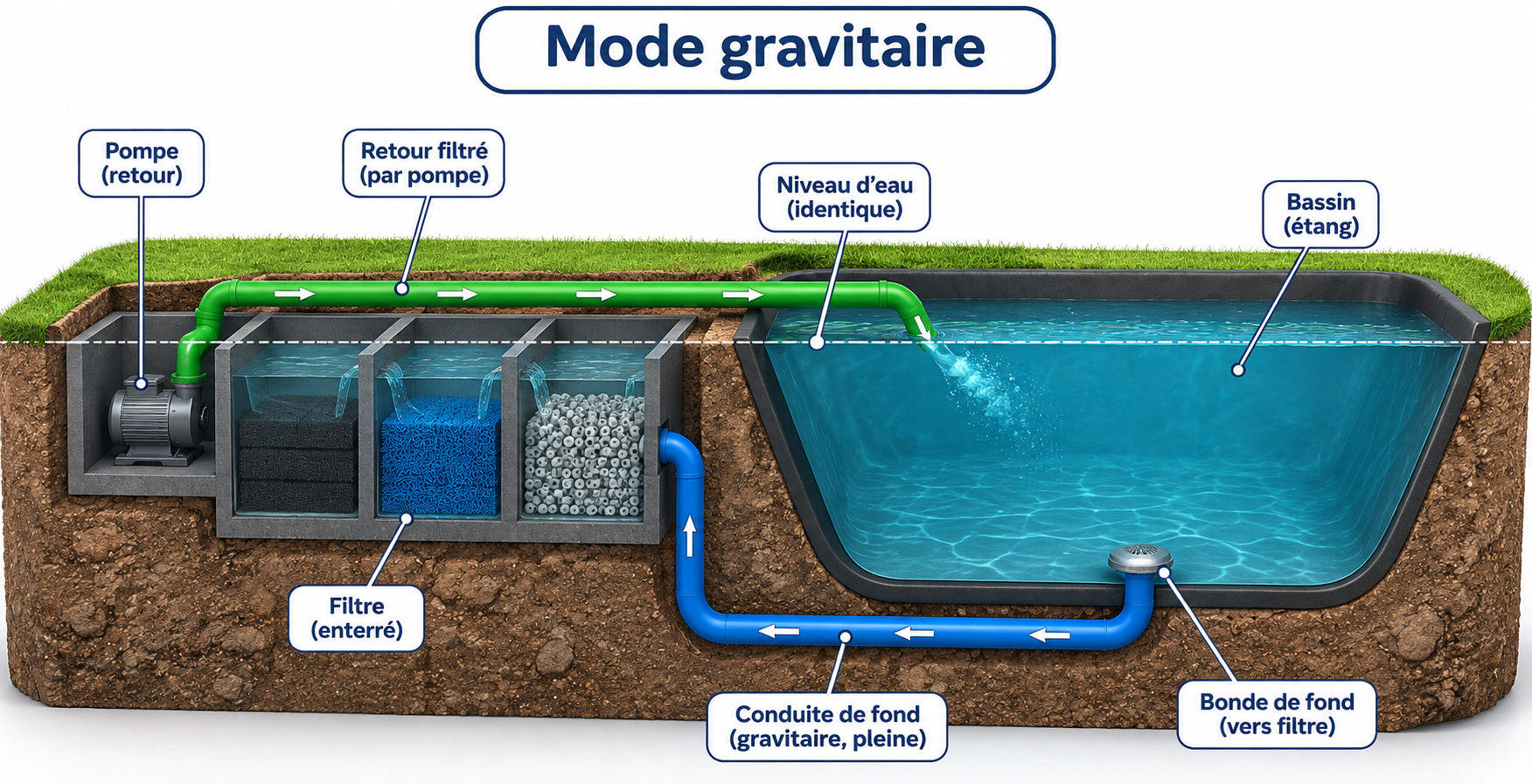
Advantage
In this case, the filter is buried and connected to the pond via one or more bottom bottom drains. This system is balanced by the principle of communicating vases; this has the effect of a minimum consumption because there is no water to raise.
In addition, as the pump is at the end of filtration, there is no mixing of waste, which greatly facilitates mechanical and biological filtration.
Disadvantage
This mode is more difficult to achieve but the game is worth the candle because it is less energy-consuming and will allow a finer mechanical filtration. This will have the effect of having fewer MES in the pond.
Semi-gravity-fed mode

This mode is mainly suitable for a grid filter. As with gravitational mode, one or more bottom plugs supply a sump in which the pump is placed.
In the case of the use of a grid filter, it will be placed just before the pump and a sump will not be required.
After the pump, water will be raised to the filter that will be placed on the ground.
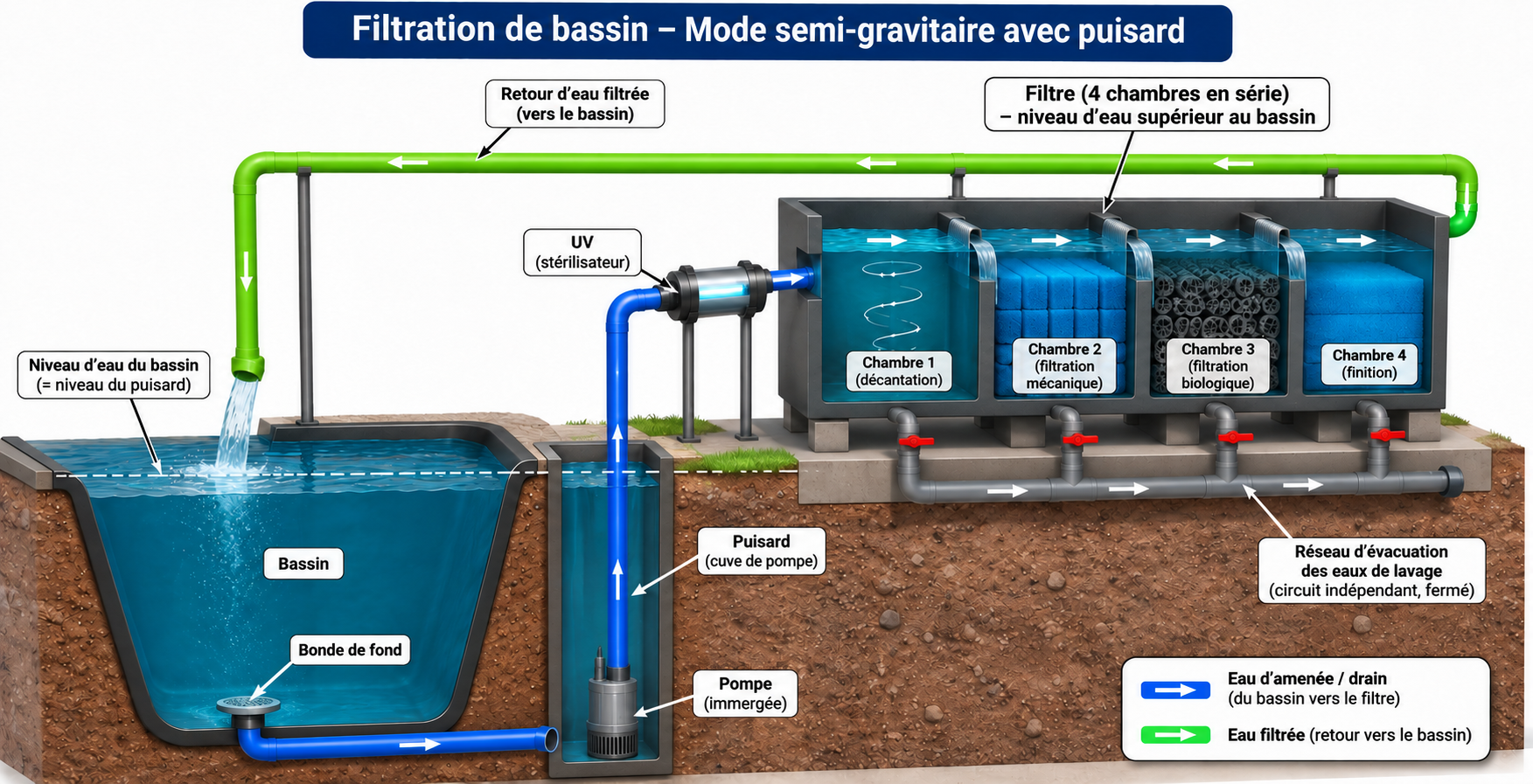
Advantage
This mode is relatively simple to place but, given the work requested, there really isn't much to do to switch to gravitational mode which, in my opinion, is the best system because it offers the most advantages.
Disadvantages
These are the same as those of pump-fed mode.