
Ozone in a koi pond
Ozone can improve water clarity and reduce the amount of microbes in treated water. It complements biological filtration. Its use requires controlling residual ozone in water and air.
What ozone brings
The ozone (O3) is a powerful oxidant. In the reactor, it can degrade some organic compounds that color water and oxidize nitrites to nitrates. The effectiveness depends on water quality, contact time and dose applied. Recirculated Aquaculture Study.
A well-sized ozonation can reduce the amount of microorganisms in the water that passes through the reactor. Ozone and UV can complement each other. The effect depends on the organisms involved and the treatment conditions. Ozone and UV study
Risks to fish and people
In the water. Residual ozone can damage gills and cause mortality. Treatment should eliminate residual ozone before water reaches the fish. Checking is done when treatment returns. Technical guide on aquaculture ozonation.
In the air. The residual gas from the reactor must be captured and treated with a suitable destroyer. The room must be ventilated. NIOSH Ozone Sheet.
How do we produce ozone?
1. Dielectric barrier discharge (DBD)
Electrical discharge is a common method in water treatment ozonators. A high voltage creates a plasma in a gas containing oxygen, between two electrodes at least one of which is isolated by a dielectric material. The discharge dissociates part of the oxygen molecules (O₂). The released atoms recombine with other oxygen molecules to form ozone (O3).
The generator can be supplied with either dry air or oxygen, depending on the model. Oxygen is usually used to produce a gas richer in ozone. With air, the discharge can also form oxides of nitrogen. The drying of the gas and cooling of the appliance help to maintain its efficiency. EPA data sheet on ozonation.
2. Ultraviolet radiation at 185 nm
A lamp emitting around 185 nm can form ozone from the oxygen of the gas. At the scale of water treatment equipment, this method usually provides a gas less concentrated in ozone than the electric discharge. In the circuit described here, UV also has another application. A unit sized for this purpose can destroy dissolved ozone prior to the return of water to the pond. Study on the destruction of ozone dissolved by UV
3. Electrochemical generation
An electrolysis cell can produce ozone from water. Some models use a polymer membrane and demineralized water. The required water quality and performance depend on the cell. This technique is used for specialized applications. Study on electrochemical production of ozone.
To compare the devices, look at the announced production in g/h and the gas used to obtain this value. The choice depends on the water flow, its demand for ozone and the safety of the circuit. Plan for redox monitoring, destruction of residual ozone and water control before it returns to the pond.
Economic ozoneor with electric discharge
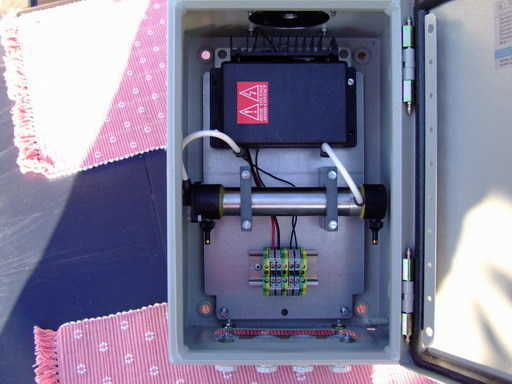
Before choosing a module to be mounted in a box, ask for its instructions and the conditions under which its production in g/h has been measured. Check in particular the gas accepted, its pressure, flow rate and drought, as well as the mode of cooling planned.
1. Oxygen concentrate
If the generator accepts an oxygen supply, an enriched gas can significantly increase its ozone output relative to dry air. A used concentrator can be considered if its condition and compatibility are checked. Have the purity, flow rate and pressure measured in continuous operation, then compare these values with the requirements of the generator. An old medical device must also be evaluated for this use. Enriched oxygen accelerates combustion. Guide to aquaculture ozonation · Scottish Fire Department.
2. Upstream gas drying
The gas must reach the dew point specified by the manufacturer at the inlet of the ozoneur. If an additional dryer is required, it is placed between the concentrator and the generator. A silica gel tube can retain part of the moisture. Its efficiency must be checked at the actual flow rate and throughout the duration of use of the cartridge. Choose a dryer and gas-compatible fittings. Manufacturer's notice on gas supply and drying.
3. Immediate stop in case of loss of circulation
If the pump that supplies the reactor stops or if the water flow becomes insufficient, immediately cut off the oxygen concentrator and the ozone generator. Serve both devices with a flow detector on the ozone branch. Reboot must be allowed only when the required water flow is restored and the circuit safety is operational.
Ventilation and independent protection
The high voltage module must be protected in a ventilated housing, suitable for the humidity of the room and inaccessible in operation. Provide for a thermal cut-off independent of the electronics of the module. If cooling is to continue after the cut-off, define the fan shut-down time or temperature after the manufacturer's limits and the measuring point. Also check automatic stops in case of loss of circulation or failure to destroy residual ozone. Manufacturer's note on cooling.
How to integrate into the circuit
Biological filtration remains essential for the transformation of ammonia and nitrites. The ozonation is done in a separate reactor, with a step of destruction of the residual before the water returns to the pond.
- Destroy residual ozone. Use a device suitable for the flow and concentration to be treated, e.g. activated carbon or a UV unit sized for this function. Study on the destruction of ozone dissolved by UV
- Allow for automatic shutdown. Have the circuit and its safety scaled by a professional. Ozone production must stop in case of loss of circulation or failure of treatment of the residual.
- Watch the redox in the right place. The redox potential (ORP) gives an indirect indication of the oxidizing state of the water. Adjustments depend on the measuring point and the material. Control of residual ozone upon return remains necessary. Study on the piloting of ozonation
The parameters to follow
Nitrites (NO₂−). Ozone can lower the concentration in treated water by transforming it into nitrates. Continue monitoring nitrites and verify the operation of the biological filter.
Total ammoniaal nitrogen (TAN). In a 200-L test of koi water, the ozone and UV combination reduced the TAN by 29% and reduced nitrites to zero after 12 hours. These results describe the conditions of this test. The monitoring of TAN and the operation of the biological filter remain essential for a garden pond. Summary of the koi study