Small reminder about air pumps:
On the one hand, air pumps operate according to the principle of a flexible membrane and two valves: an intake and an exhaust. On the other hand, it is not necessary to use a compressor in any case because it uses oil to lubricate the bearings and piston. The oil mixed with water would inevitably end up in the water of your pond and cause pollution of your pond.
In addition, a compressor gives a significantly higher pressure than an air pump, which is not useful. It also consumes much more energy.
The air pump will always be placed higher than the water level. Otherwise, it is imperative to use one or more non-return valve(s). Otherwise, when the pump stops (e.g. a power cut), you may have a siphon effect. The water would then pass through the pump system to overflow by suction. This could lead to the complete destruction of the pump.
Currently, there are no pumps that can stay in the rain outside. Therefore, a shelter must be provided. These pumps do not accept temperatures below -10°C, which is another reason for providing a shelter. If you have a garden shelter, it will do the job, even if it is far from the pond, the length of the pipes does not affect the flow.
There are a large number of pump models
- Let's start with the smallest models designed to work with one or two bubblers suitable for very small ponds. These pumps are usually from aquariophilia and, therefore, are very sensitive to an outdoor environment. Sometimes they are offered in a plastic box to protect them from the weather.
- This type of pump will already be more suitable for the pond. It can supply from 6 to more than 10 bubbles. Compared to high-end models, two important factors need to be taken into account:
- First of all, the noise. This air pump is louder. If you are lucky to have a garden shelter, the noise will not bear consequence.
- Secondly, energy consumption. However, the differences will be less marked than for water pumps.
- Finally come the high-end pumps. Of course, all at a price! Apart from the cost, these devices will offer a high efficiency with limited consumption for maximum flow. More importantly, these pumps have a greater longevity. Let's not forget that they will operate 24 hours a day and 365 days a year. The icing on the cake: these pumps are very noisy. This criterion of choice will be decisive if you live in an urban area.
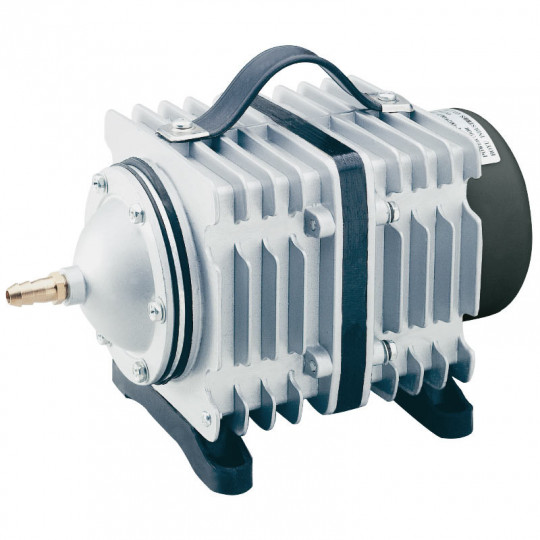
Example of compressor
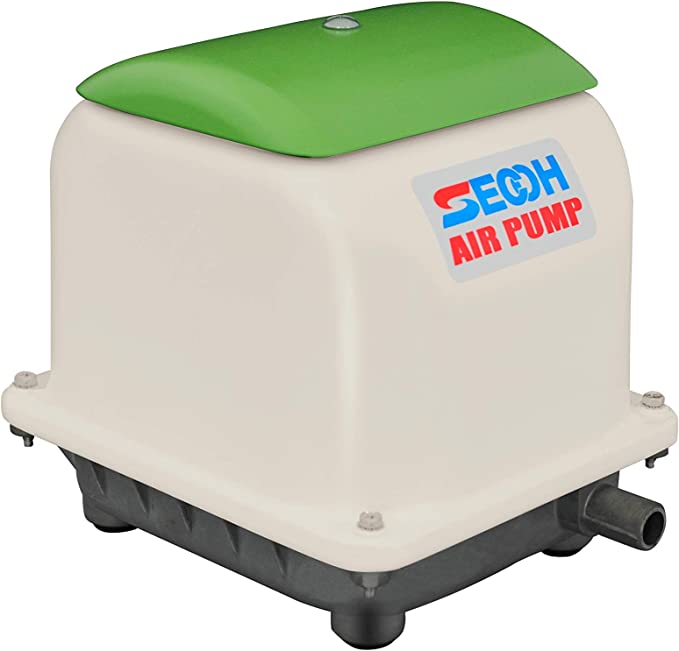
Example of a high-level air pump
What applications for the air pump?
The pump and bubblers will be used during the good season to oxygenate mainly the filter. Indeed, when you place bubblers in the Bio compartments of your filter, these will significantly increase the filtration capacity by multiplying the bacteria of the filter.
You can place a few bubblers directly in the pond, in stagnant water areas.
In winter, it is wise to place one or more bubblers in the pond in order to keep free water allowing the degassing of the methane present due to the decomposition of organic matter in the pond. Indeed, life continues under water, even at idle. These bubblers will be placed at a low depth of 10 cm in order to create a whirlwind on the surface.
Another application: the moving bed that will allow you to move filter media into the biological filter. To do this, you will need a 60l/minute pump at least to get the media moving. The goal is that all media are in motion. Avoid a stagnant area. That's why you will need several bubblers in the tank, even a Japanese pipe.
Compressor or membrane pump?
The difference between these two types of pumps is very significant: the compressor is noisy and more energy-intensive. However, it allows the bubblers to be placed deeper.
The membrane pump is less noisy and, in most models, the membranes are replaceable, which gives it a greater longevity. However, this type of pump does not allow the bubblers to be placed very deep (60 cm or less) in the pond.
Since this type of pump oscillates 50 times per second, it is recommended to change the membrane every year. You will have an air pump that will work for many years.
How to properly place the pump and bubblers?
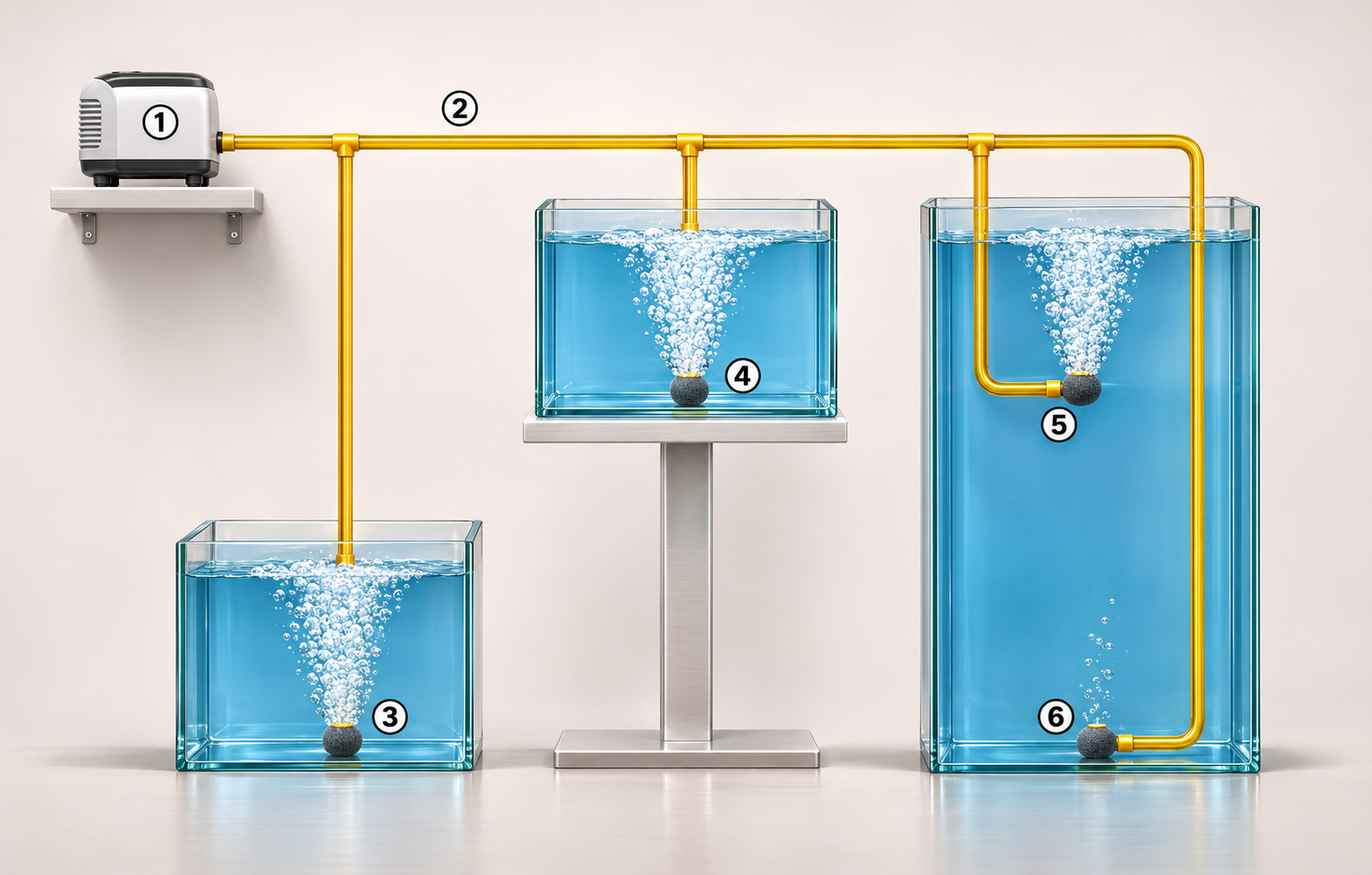
A little reminder of physics:
The pump (1) is higher than the water or filter level, the air is brought by tubes (2), which must be in accordance with the diameter indicated by the manufacturer.
What do we see in this diagram? If you place a bubbler at a given depth, as in 3.4 and 5, the flow rate of each bubbler will be identical. However, if you place a much deeper bubbler (6), you will have a flow rate that will decrease depending on the depth of the bubbler because of the backpressure exerted by the water column above the bubbler.
Note that if you have two ponds at different heights, it doesn't matter if you place the bubblers at the same depth. What is important is the water column above the bubble.
So, it's very important to put all the bubblers at the same depth if we want to keep a balance in those bubbles.
Another very important remark. First case: This type of pump cannot work on a stopper (e.g. with a distributor whose valves are all closed) Second case: if your bubblers are placed too deep. The consequence for the pump would be the same: destruction of the membrane or diaphragm. We will say that, in general, a bubble should not be placed at a depth greater than 1 m, which is already important.
The number of bubblers, or Japanese pipes, will be determined by the flow rate of the air pump and the air consumption of the bubblers or Japanese pipe. Example: the consumption of a bubbler is 5 liters per minute; if you have an air pump of 20l/m, this will allow you to place 4 bubblers.
In the case of Japanese pipes, for those who want to replace them with microporous hose watering, the air consumption will be undetermined. Moreover, the bubbles will be larger than with a Japanese pipe. This necessarily means placing an air pump of greater capacity, which will lead to a higher electricity consumption!
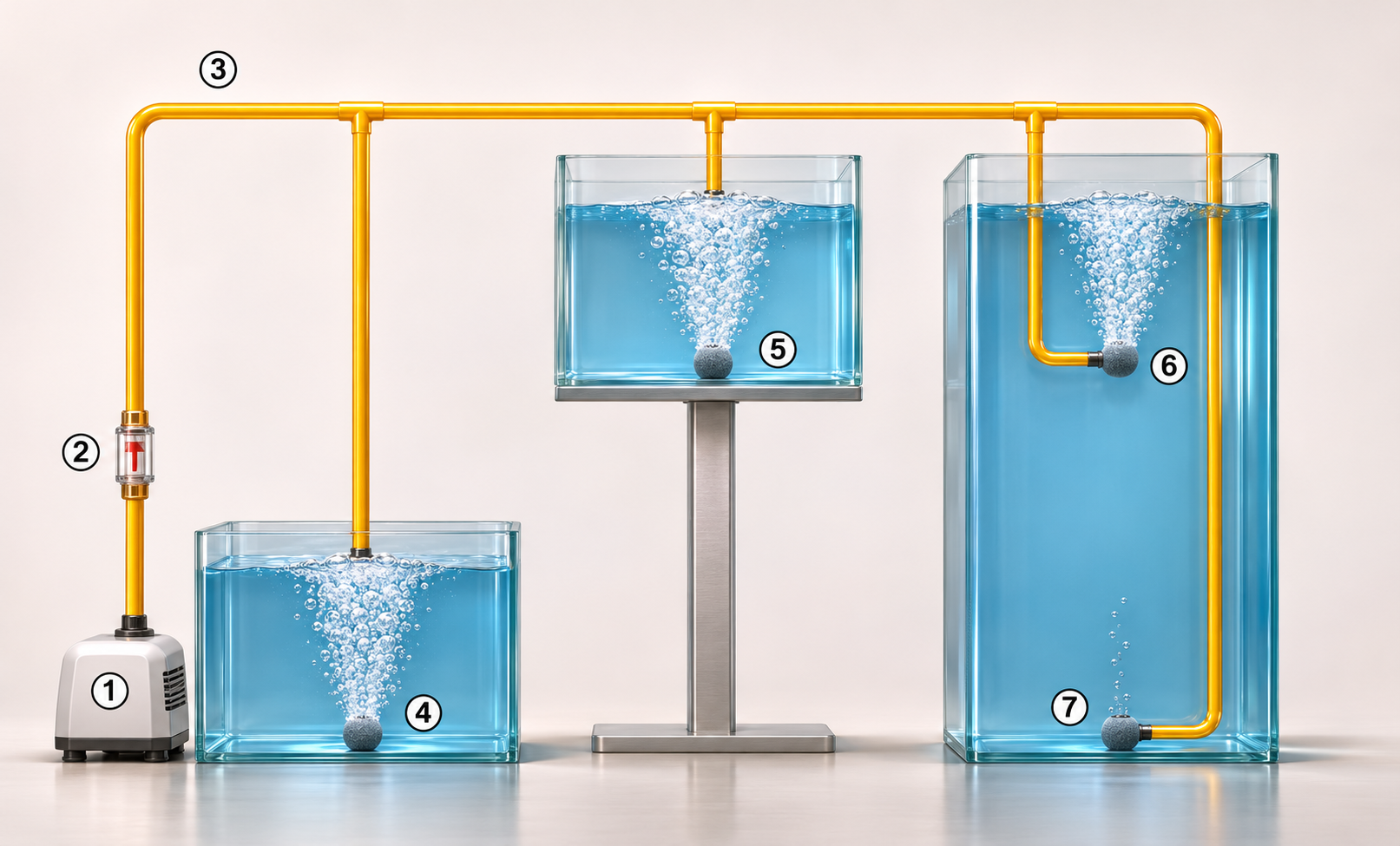
In the above diagram, we see that the pump (1) is placed below the water or filter level. In this case, it is imperative to place a non-return valve (2) in order to avoid the water, by siphon effect, being able to pass through the pump. In this instance, there is only one valve. You can also use a series of non-return valves on 4mm fine tubes that supply the bubblers.
For the rest, the principle is the same with regard to the placement of bubblers.
Important remarks:
On the one hand, in case you place your air pump in a closed room in which the filtration is located, it is imperative to overvent it in order to limit moisture in the room, as there is always condensation due to the evaporation of the filter water.
On the other hand, it is necessary to avoid pumping the gases released by the filter (ammonium, ammonium) and reinjecting them into the filter through bubbles. This will prevent the presence of nitrites permanently.
When can we stop the pump?
There are several examples:
When the water temperature passes below 10°C in the pond.
One bubble is kept active if there is a risk of freezing.
You can stop the pump during filtration cleaning, but for a short time.
For the moving bed, there is no question of stopping the air pump, I even advise you to have an air pump in reserve so that you can intervene quickly in case of a breakdown!
I have offered you an overview of the base of the air pumps. It is a very interesting tool because it increases, in an extraordinary way, the filter capacity of your filter and allows, in winter, to keep water free in order to remove the pond.