
The oxygen needs of your pond water
This article will allow you to understand everything that relates to oxygenation in your pond. You will find out all the stakeholders. You will know how to have the best oxygen level possible for your fish, especially your koi carp, during the most active season of the year.
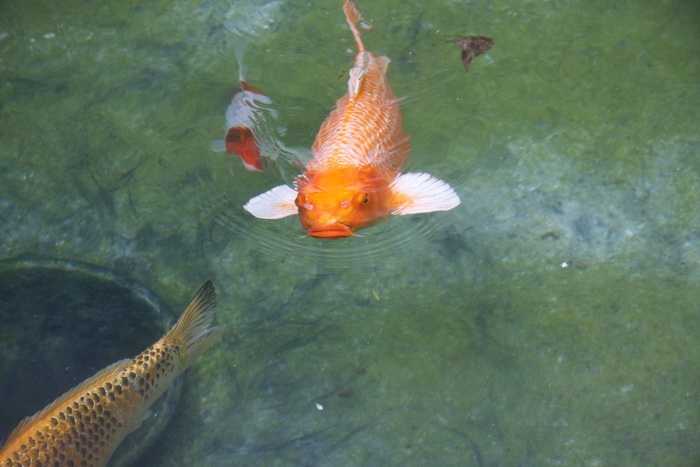
Oxygenation of the water in your pond is essential for all aquatic life.
Dissolved oxygen
Dissolved oxygen is present in the form of O₂ molecules in water. Fish, plants and aerobic bacteria use it to breathe. Exchanges with air and photosynthesis help to renew this oxygen. Dissolved oxygen reference.
Dioxygen (O₂)
Dioxygen is a molecule composed of two oxygen atoms, which is in the state of gas at normal atmospheric pressure and temperature conditions.
It is also called an oxygen molecule and, in the current language, in the absence of ambiguity with the chemical element of the same name, it is very often misrepresented by the term oxygen. It makes up 20.95% of the volume and 23.2% of the mass of the Earth's atmosphere. It is an essential gas for many life forms to which it provides oxygen necessary for the respiration of cells. It is not, however, indispensable for certain so-called optional anaerobic bacteria and it is even fatal for strict anaerebic bacteria. (Wikipedia)
Air pressure
The atmospheric pressure is, with temperature, wind speed and direction and relative humidity, one of the five basic parameters used to characterize the state of the low and medium atmosphere in meteorology. It undergoes much faster spatial and temporal variations on the vertical than on a horizontal surface where its distribution, at a given moment, is described in terms of anticyclones, depressions, dorsals, thalwegs, etc.
The normal atmospheric pressure (or standard atmospheric pressure) is the pressure exerted at mean sea level by a vertical column of 760 millimetres of mercury at 0 degrees Celsius. Its value is 1013.25 hPa (hectopascal).
In meteorology, this number can be considered as an accurate estimate of the average atmospheric pressure values at mean sea level in temperate areas. Therefore, it is appropriate to select this number in order to distinguish at this level those regions where the pressure is higher or lower than the average, i.e. above or below the normal atmospheric pressure. However, it is practically rounded to the value of 1015 hPa for needs. (Weather France).
The atmospheric pressure is measured using a barometer. Surface atmospheric pressure under normal conditions is around 1013 millibars or usually considered to be the equivalent of 1 bar.
To determine the oxygen content in water as a function of temperature and atmospheric pressure in normal time 1013.25 hPa or 1013 millibars. (see table below)
Temperature and saturation
Indicative saturation values for fresh water at standard atmospheric pressure, i.e. about 1,013 hPa. The content actually measured in a pond may be different.
| Temperature (°C) | Oxygen (mg/L) |
|---|---|
| 1 | 14,22 |
| 2 | 13,83 |
| 3 | 13,46 |
| 4 | 13,11 |
| 5 | 12,77 |
| 6 | 12,45 |
| 7 | 12,14 |
| 8 | 11,84 |
| 9 | 11,56 |
| 10 | 11,29 |
| 11 | 11,03 |
| 12 | 10,78 |
| 13 | 10,54 |
| 14 | 10,31 |
| 15 | 10,08 |
| 16 | 9,87 |
| 17 | 9,66 |
| 18 | 9,47 |
| 19 | 9,28 |
| 20 | 9,09 |
| 21 | 8,92 |
| 22 | 8,74 |
| 23 | 8,58 |
| 24 | 8,42 |
| 25 | 8,26 |
| 26 | 8,11 |
| 27 | 7,97 |
| 28 | 7,83 |
| 29 | 7,69 |
| 30 | 7,56 |
| 31 | 7,43 |
| 32 | 7,30 |
| 33 | 7,18 |
| 34 | 7,06 |
| 35 | 6,95 |
Calculation relationship USACE
| Temperature °C | Oxygen content mg/L |
| 1 | 14.06 |
| 2 | 13.77 |
| 3 | 13.40 |
| 4 | 13.05 |
| 5 | 12.73 |
| 6 | 12.37 |
| 7 | 12.06 |
| 8 | 11.76 |
| 9 | 11.47 |
| 10 | 11.19 |
| 11 | 10.92 |
| 12 | 10.67 |
| 13 | 10.42 |
| 14 | 10.20 |
| 15 | 9.98 |
| 16 | 9.76 |
| 17 | 9.56 |
| 18 | 9.37 |
| 19 | 9.18 |
| 20 | 9.1 |
| 21 | 8.68 |
| 22 | 8.53 |
| 23 | 8.38 |
| 24 | 8.25 |
| 25 | 8.11 |
| 26 | 7.99 |
| 27 | 7.86 |
| 28 | 7.75 |
| 29 | 7.64 |
| 30 | 7.53 |
| 31 | 7.42 |
| 32 | 7.32 |
| 33 | 7.22 |
| 34 | 7.13 |
| 35 | 7.04 |
The effect of salinity
If, for any reason, you need to put salt in the water of your pond, it should be noted that the salt considerably reduces the solubility of oxygen in the water, hence the need to oxidize well the water in the pond during this period. Example: In fresh water at 20 °C, the solubility is 9.1 milligrams of oxygen per litre of water. In seawater at the same temperature, it will only be 7.4 mg/l. It is understood that with a high level of salt, the level of oxygen in water will be greatly reduced.
Photosynthesis
Photosynthesis is the bioenergy process that allows plants to synthesize their organic matter by using solar energy. The photosynthesis by which green plants, submerged plants (oxygenating) and phytoplankton (single-cell algae) ensure their growth by producing organic matter, produces oxygen. This is normal because this is the balance throughout the whole growth, production of substance with oxygen release but which takes place only in the presence of light. It is for this reason that the water contains a maximum oxygen in the afternoon, level of oxygen which decreases during the night. At night, photosynthesis is suspended but plants, unicellular algae and many others breathe continuously and, as a result, absorb dissolved oxygen and can cause oxygen depletion before morning. It can still happen that unicellular algae die for one or more reasons, decompose and exhaust oxygen from the water of the pond. Water contains organisms that cannot make photosynthesis (most bacteria, moulds, animals); oxygen is consumed by breathing and carbon dioxide that is emitted will also contribute to acidification of the water in your pond. You have certainly seen that, at night, during the most active season, your pond also needs high oxygenation and that the pH is lowest at dawn.
Gaseous exchange
The physics of the dissolution of atmospheric gases in water
These gases are nitrogen (about 78%), oxygen (about 21%), water vapour (very variable), carbon dioxide (about 0.03%) and various other gases (argon, neon, krypton, etc.). Two physical factors are to be considered: temperature (the lower it is, the more liquid water dissolves the mentioned gases) and atmospheric pressure (the same volume of water dissolves more gas at low than at high altitude). Water agitation does not act on the values of gas balance between water and atmosphere but it accelerates the process of dissolution when the equilibrium is not achieved. This is what a cascade in a pond does.
Oxygen requirements
The fish and the biological filter consume oxygen continuously. Follow the concentration with a suitable device, especially in the early morning and during high heats. Heat reduces the solubility of oxygen and can increase the consumption of the pond.
Air pressure also occurs in equilibrium with air. A drop in pressure alone does not predict the actual decrease in oxygen in the pond.
Oxyze the pond well
Oxygen deficiency occurs when consumption exceeds production.
The reasons why it is important to properly oxygenate the water from the pond and filtration are, on the one hand, that there are a lot of oxygen users throughout your pond. On the other hand, your fish, bacteria from your biological filtration, bacteria in your pond, submerged plants, single-cell algae (phytoplankton), micro-organisms (zooplankton) and everything that is decomposing throughout the pond, consume a great deal of oxygen.
It can be seen that there is a high demand for oxygen so that the pond maintains a good balance and sufficient oxygen content for all aquatic life. If we refer to the Truesdale table, we read oxygen levels for water that does not undergo all of the factors mentioned in the oxygen consumption. This makes us understand that without additional oxygen intake and levels at the table references, we would be quickly below the 6 mg/l standard by high heat.
What would happen if there was a high atmospheric depression in a period of high heat? There would then be a short oxygen deficiency, of course, (a few hours) but, some times, very pronounced, resulting in a possible mortality among your fish.
Technical or more natural means, such as a cascade, will allow you to easily oxygenate the water in the pond. Bubblers powered by an air compressor for the biological filter or pond will aerate the water by increasing the exchange surface between water and ambient air.
Understanding saturation
Saturation is the equilibrium concentration between water and air at a given temperature, pressure and salinity. At 20 °C, in freshwater near sea level, it is approximately 9.1 mg/L.
The saturation percentage is calculated by dividing the concentration measured by the saturation concentration, then multiplying by 100. Aeration accelerates the exchange with air. Freshwater saturation table
Gas oversaturation
Water may exceed 100% saturation, especially during high photosynthesis or after contact with pressurized gas. The risk to fish depends on the gases involved, their total pressure, duration of exposure and species. Therefore, a single limit in mg/L of oxygen is not sufficient to assess this risk. Guide on Dissolved Gases in Aquaculture.
Oxygenation of filtration
In a biological filter, the air supply brings oxygen to the bacteria and promotes gas exchange. In a moving bed, it also maintains the supports in motion. These supports carry the biofilm that participates in water treatment.
In the event of a prolonged cessation of ventilation or circulation, the filter may lack oxygen. Monitor the operation of pumps and diffusers as well as the quality of water when restarting.