
The Patpre2000 multi-drum
DIY DIY · Part 1: the preparation of cans
This little report will try to explain to you the realization of a filter based on the principle "multi-drum", already explained by Keeppool and Artgraphbegain. Inspiration also came from Atlantic with its multi-IBC tank, as well as from Imkal for its grid and its principle of backwashing: any resemblance with already made montages is therefore absolutely not accidental.
The growing fish, the BIOTEC 10 and its prefilter were no longer enough for the 7,000 liters of my pond. Water remained transparent, but it was impossible to obtain a zero nitrite level.
The initial situation
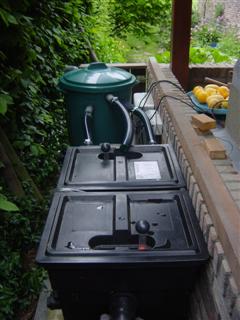
This is my starting point: a BIOTEC 10 and a brush prefilter. Biological filtration was insufficient and did not achieve a sufficiently low nitrite level.
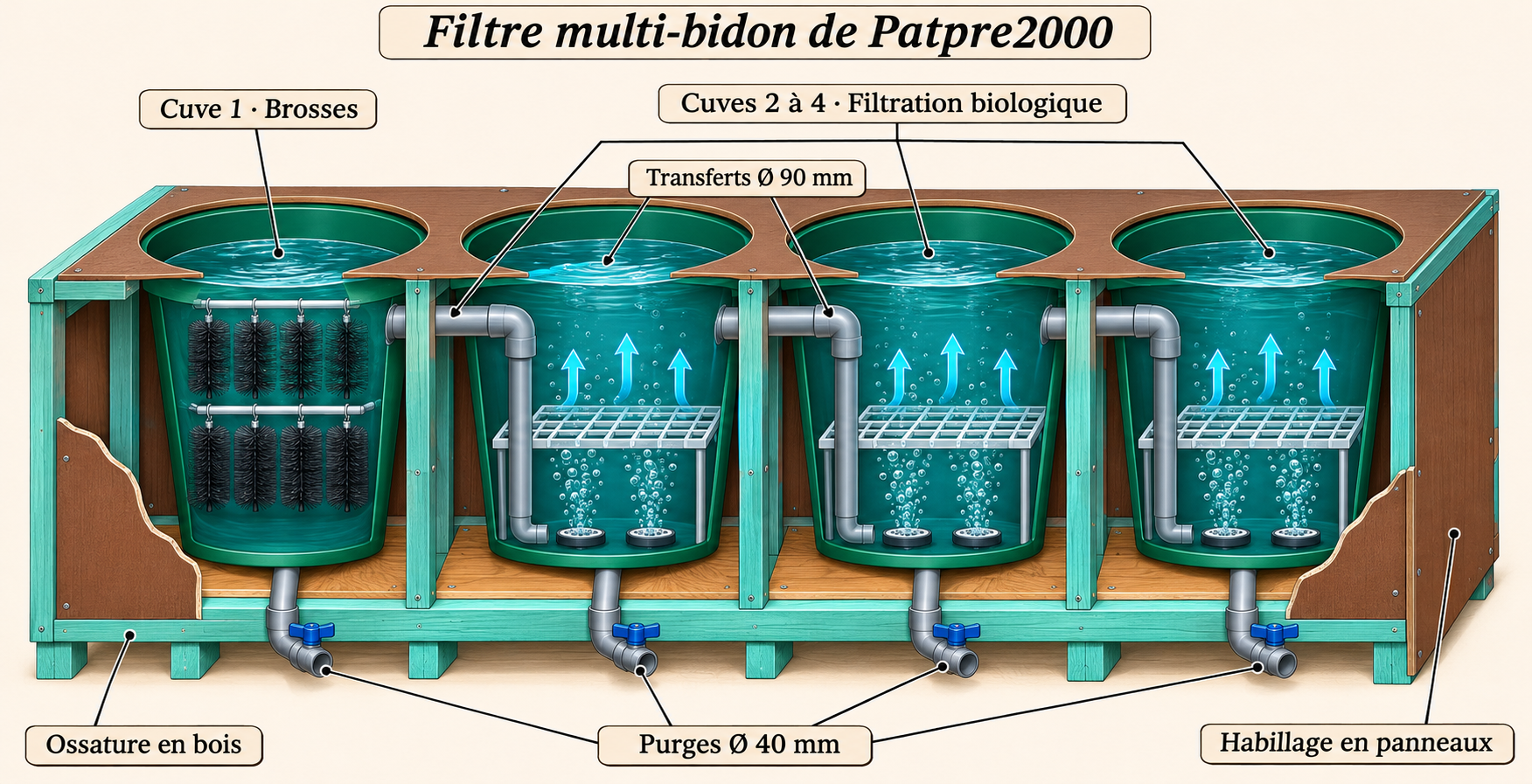
Hence the idea of building a multi-drum filter, in the available space of 2.50 m by 70 cm.
Here's the filter project
Prepare the vats
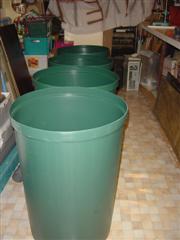
The cans are initially rainwater recovery tanks with a capacity of 240 litres.
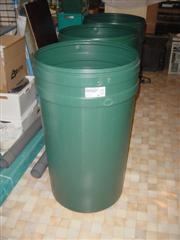
The top of the cans has many grooves that stiffen the whole and allow to fix the lid. However, they make it difficult to seal. The cans are also too high, a cut causes about 40 litres of capacity to lose, but will facilitate further work.
The passages between the cans
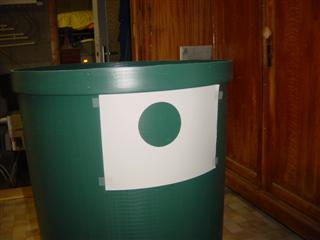
A small pattern identifies the 90 mm hole to be cut to transfer water from one can to another.
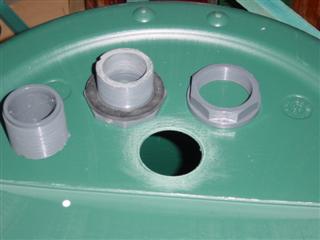
We must not forget the hole at the bottom of the cans for the parsley passages of the backwash purges, 40 mm. A weld distorting the bottom, the exits cannot be placed in the center: they are therefore slightly shifted. The left part is a part of the wall passage that I shortened.
Upstream water transfer
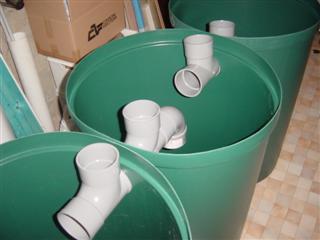
The transfer uses two T connections. The first, of the FFF type (three female links), crosses the two walls of the cans. A second, of the MFF type (one male end and two female brackets), followed by a 90° elbow and a piece of pipe, leads water to the bottom of the next can. The water then goes up through the filter media: This is the principle of ascending flow, or upflow.
A production of Patpre2000 for Aquatechnobel.